


The Practice Library
The Practice Library™ includes curated reflections, clinical insights, and educational resources drawn from my work in therapy, clinical supervision, and systems consultation.
These writings are designed to support thoughtful clinical growth beyond the therapy session — particularly for clinicians seeking to strengthen documentation, clinical reasoning, and ethical practice.
If you are a clinician in Washington seeking supervision or consultation, or would like to receive updates as new resources are added:
All content is the intellectual property of SB Webb Counseling & Consulting PLLC and is protected by copyright. Materials are shared for informational purposes only and are not a substitute for individualized clinical care.
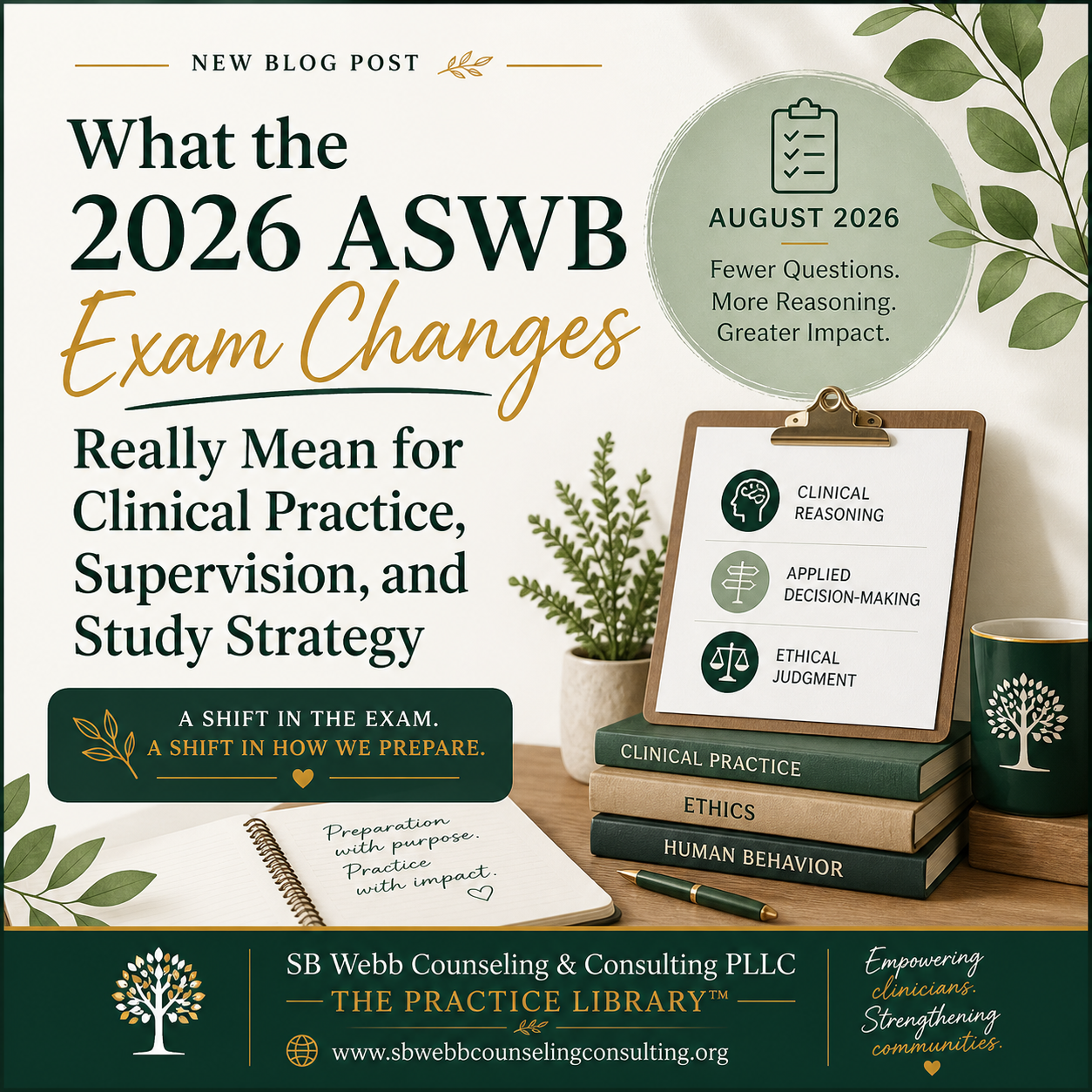
What the 2026 ASWB Exam Changes Really Mean for Clinical Practice, Supervision, and Study Strategy
Big changes are coming to the ASWB licensure exams in August 2026—and they reflect more than a testing update. In The Practice Library™, Shannon Webb, LICSW, examines how this shift toward clinical reasoning and applied decision-making impacts clinician preparation, supervision, and access to licensure.
From Diagnosis to Understanding: What the DSM-5 -TR Doesn’t Teach You About Clinical Thinking
Learning the DSM-5-TR is foundational—but it is not the same as learning how to think clinically. In this Practice Library™ article, Shannon Webb, LICSW explores how diagnosis evolves from classification into clinical formulation, shaped by systems, context, and lived experience. This piece bridges classroom learning and real-world practice for clinicians in training and beyond.
What Happens After the Interview: Onboarding, Culture, and the Systems That Shape Clinical Practice
What happens after the interview is where clinical practice is actually formed. In this article, Shannon Webb, LICSW, LCSW, BCD examines how onboarding, team culture, and system design shape not only clinician development—but retention, burnout, and client care outcomes.
Through The Practice Library™, she offers a systems-informed, clinically grounded perspective on building sustainable behavioral health practice.
The First Five Years of Clinical Practice: Why Therapists Burn Out Early
New in The Practice Library™
Written by Shannon Webb, LICSW, this article examines why burnout in early career clinicians is not a failure of resilience—but a reflection of how we develop, supervise, and support therapists within complex systems.
Becoming an Approved Supervisor in Washington: Beyond the 25-Hour Requirement
In this The Practice Library™ Article, Shannon Webb explores what it really means to become an approved supervisor in Washington State. This article goes beyond the 25-hour requirement to examine supervision, systems, and the real-world responsibility of guiding another clinician’s work.
Let’s Graduate: Rethinking How We End Therapy
In this Practice Library™ article, Shannon B. Webb, LICSW, explores how graduation from therapy and discharge planning can be approached as a meaningful clinical process—integrating readiness, ethics, and relational care, rather than reducing it to a simple case closure.
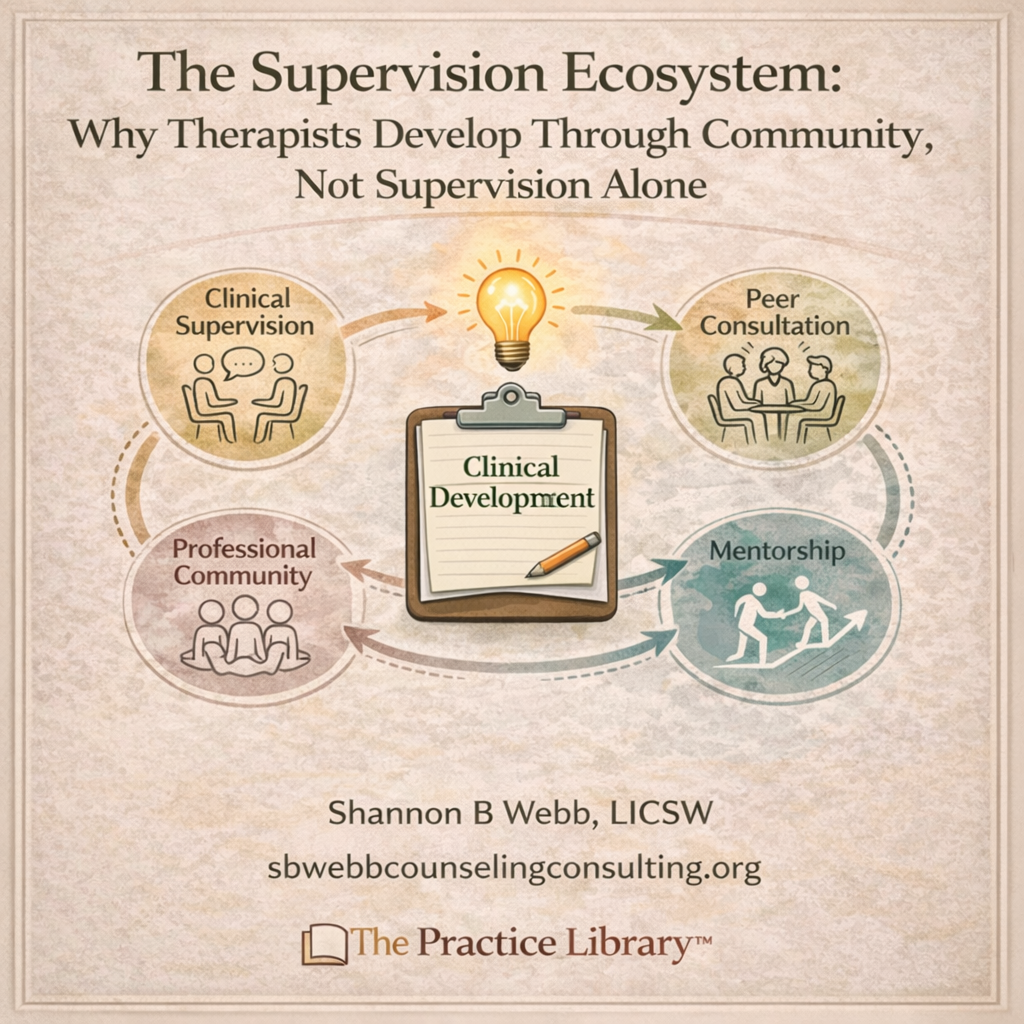
The Supervision Ecosystem: Why Therapists Develop Through Community, Not Supervision Alone
In this Practice Library article, Shannon B. Webb, LICSW expands on earlier reflections on clinical supervision and therapist development by further defining the Supervision Ecosystem Model. The article explores how clinicians develop through interconnected systems of supervision, consultation, mentorship, documentation training, and professional community—and why supervision alone is not sufficient to support clinical competence and long-term sustainability.
Uplift the Workforce: Why Clinical Supervision Is More Than Oversight
Clinical supervision is more than a regulatory requirement — it is where therapists develop clinical judgment, professional identity, and ethical practice. In this Practice Library article, Shannon B. Webb, LICSW explores therapist development, the supervision ecosystem, and why professional community is essential for sustaining the behavioral health workforce.
What Auditors Actually Look For in Behavioral Health Documentation
What do auditors actually look for in behavioral health documentation? In this Practice Library article, Shannon B. Webb, LICSW examines medical necessity, documentation defensibility, psychotherapy billing alignment, and the golden thread connecting assessment, diagnosis, treatment planning, and progress notes.
Who Helps the Helpers?
In this Practice Library Social Work Month reflection, Shannon B. Webb, LICSW examines burnout, workplace bullying, and the mental health of helping professionals. The article explores post-training isolation, the emotional cost of caring, and why structured support remains essential across the helping professions.
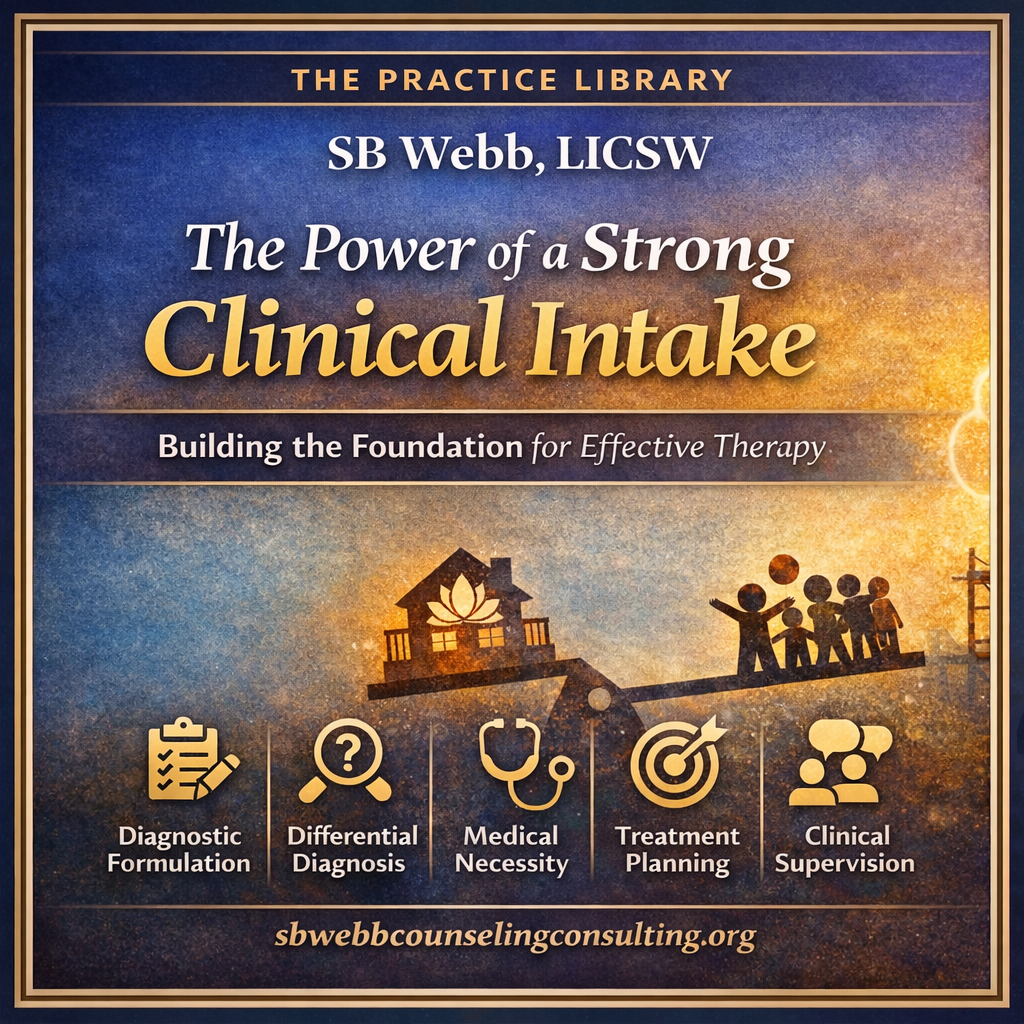
The Clinical Intake: Where Diagnosis, Treatment, and Modality Begin
The clinical intake assessment is more than a form — it is the foundation of diagnostic formulation, differential diagnosis, medical necessity documentation, and treatment planning. In this Practice Library article, Shannon B. Webb, LICSW, offers structured guidance for therapists and clinical supervisors seeking to strengthen case conceptualization, documentation clarity, and defensible behavioral health records in Washington and telehealth practice.
Social Work Month 2026
Social Work Month 2026 invites us to reflect on NASW’s theme: Uplift. Defend. Transform. This is more than a celebration of the profession — it is a call to examine the sustainability, safety, and systems that shape social work practice today. As a licensed clinical social worker, Board Certified Diplomate (BCD), and NASW member, I explore what this theme truly requires of us.
Managing Depression: Clinical Strategies for Breaking the Cycle of Withdrawal and Rumination
Depression is not a lack of willpower—it is a reinforcing cycle. Reduced activity, rumination, cognitive distortions, and withdrawal interact in ways that sustain depressive symptoms. Effective treatment focuses on interrupting this cycle through approaches that increase engagement, challenge distorted thinking, and restore connection. In this Practice Library article, Shannon Webb, LICSW highlights evidence-informed strategies—including behavioral activation, cognitive restructuring, and relational connection—to help interrupt depressive patterns and support recovery.

When Work Ends: Layoffs, Ambiguous Loss, and Reclaiming Stability
Professional layoffs are more than financial events — they are psychological transitions. In this Practice Library article, Shannon Webb, LICSW explores ambiguous grief, nervous system regulation, and identity reconstruction following job loss. Clinical perspective for adults navigating professional change in Washington & Idaho.
The Therapist as Pilot: Preparing for Takeoff, Navigating Turbulence, and Landing the Session Well
Therapy is not just what happens in the middle of the session. It’s how we regulate at the beginning, how we navigate emotional turbulence, and how we land safely at the end. In this trauma-informed guide, Shannon Webb, LICSW explores co-regulation, the window of tolerance, polyvagal theory, and session structure as clinically defensible interventions — not just rapport. Clinical supervision available in Washington. Consultation offered in WA & ID at sbwebbcounselingconsulting.org.
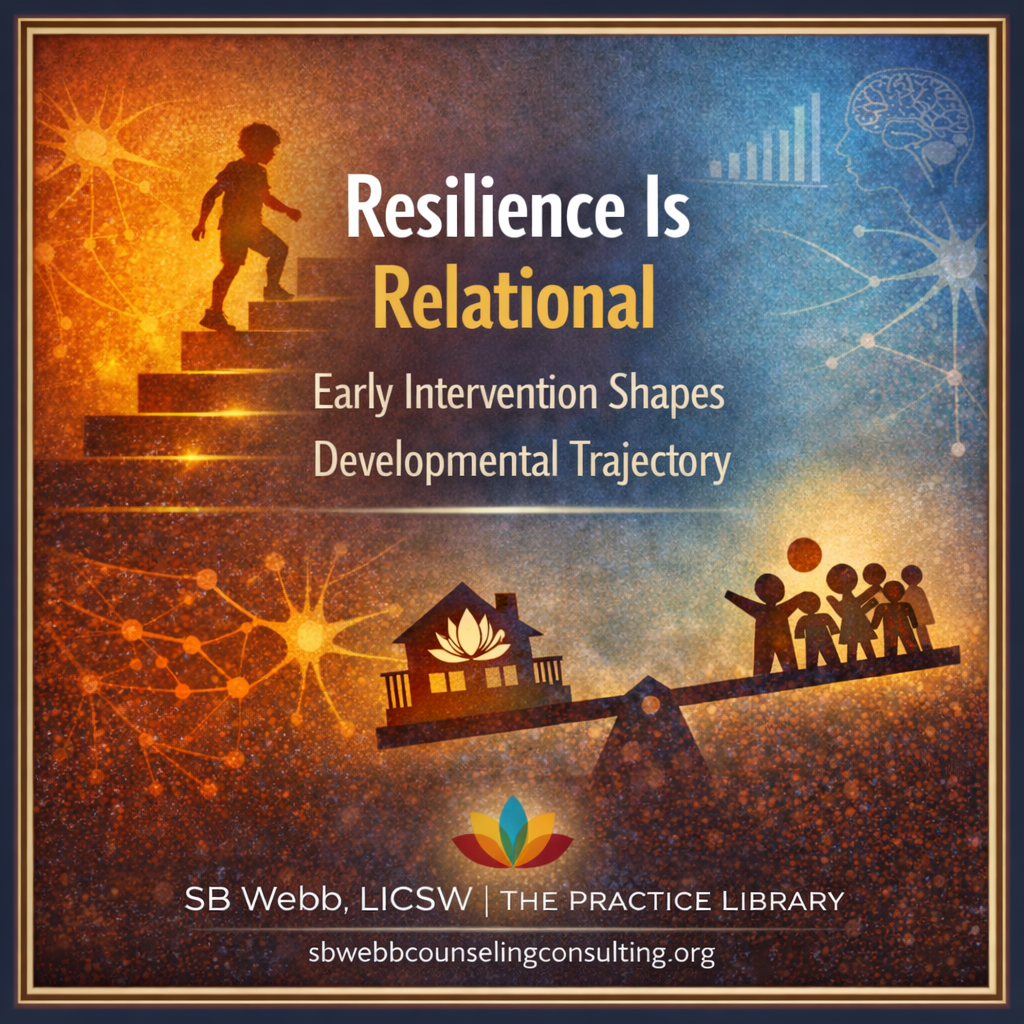
Resilience Is Relational: ACEs, Ambiguous Loss, and the Responsibility to Build Stability for Children
Childhood adversity does not determine destiny — but it does shape developmental trajectory. In this Practice Library feature, Shannon Webb, LICSW explores ACEs, ambiguous loss, positive childhood experiences, and why resilience is relational, not individual. For clinicians, educators, and leaders in Washington and Idaho, this article examines why early intervention, school-based supports, and child mental health investment are foundational to long-term community stability. Clinical supervision available in Washington. Consultation offered in WA & ID at sbwebbcounselingconsulting.org.
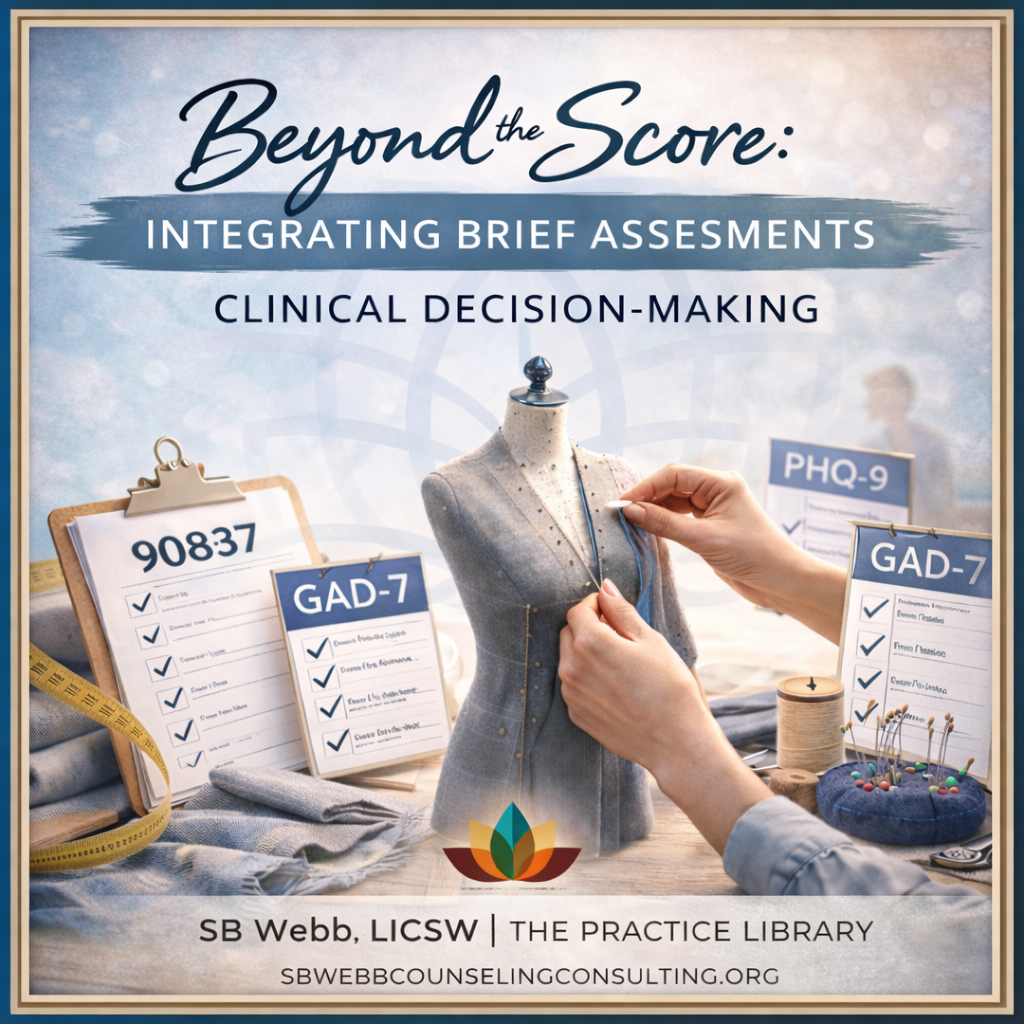
Beyond the Score: Integrating Brief Assessments into Clinical Decision-Making
A PHQ-9 score does not make a diagnosis — and a number alone does not establish medical necessity. In this Practice Library article, Shannon Webb, LICSW explores how to integrate brief assessments like the PHQ-9, GAD-7, and PCL-5 into trauma-informed case formulation, treatment planning, and defensible outpatient documentation. Learn how to move beyond the score and apply measurement-informed care with clinical precision. Clinical supervision available in Washington. Consultation offered in WA & ID at sbwebbcounselingconsulting.org.

Beyond 90837: Are You Ordering the Entrée and Forgetting the Sides?
Most therapists are fluent in CPT 90837. It’s the entrée of outpatient psychotherapy. But many clinicians overlook the “sides” — add-on codes like interactive complexity (90785) and brief behavioral assessments (96127) that reflect the full scope of clinical work. In this Practice Library article, Shannon Webb, LICSW explains when these codes are appropriate, how to document them clearly, and how accurate coding supports compliance, audit protection, and financial sustainability. Clinical supervision available in Washington. Consultation offered in WA & ID at sbwebbcounselingconsulting.org.
Beyond Imposter Syndrome: Supervision, Community, and the Workforce We’re Building
Imposter syndrome in therapists isn’t always about confidence. Often, it’s about isolation, trauma exposure, ethical complexity, and system pressure carried without enough containment. In this Practice Library article, Shannon Webb, LICSW explores how supervision, consultation, and clinical community function as protective factors in sustaining mental health professionals — and why connection is not optional in this work. Clinical supervision available in Washington. Consultation offered in WA & ID at sbwebbcounselingconsulting.org.
Who Holds the Helpers?
Who holds the helpers? In this Practice Library article, Shannon Webb, LICSW offers a trauma-informed examination of secondary trauma, vicarious trauma, and suicide risk among mental health professionals. Grounded in clinical ethics and supervision practice, this piece explores systemic pressures, professional isolation, and why meaningful supervision must function as a protective factor within behavioral health systems.
Clinical supervision available in Washington. Consultation offered in WA & ID at sbwebbcounselingconsulting.org.

Follow The Practice Library™
New articles, clinical reflections, and resources are added periodically.
If this way of thinking about clinical practice, trauma, and professional development resonates, there are several ways to work together.
Continue the Work
Apply for Clinical Supervision
For clinicians pursuing licensure in Washington State and seeking reflective, structured supervision.
Request Professional Consultation
For clinicians, practice owners, and organizations seeking support with clinical decision-making, documentation, and systems-level work.
Explore Speaking & Professional Engagement
If you are interested in a Presentation, Workshop, Panel Discussion, Guest Lecture, or Interview then lets collaborate.