

What the 2026 ASWB Exam Changes Really Mean for Clinical Practice, Supervision, and Study Strategy
SB Webb Counseling & Consulting PLLC | The Practice Library™
sbwebbcounselingconsulting.org
As we recognize Mental Health Awareness Month, many of our conversations focus on access to care. But just as important is how we prepare the clinicians providing that care.
This year, there is a significant shift happening behind the scenes.
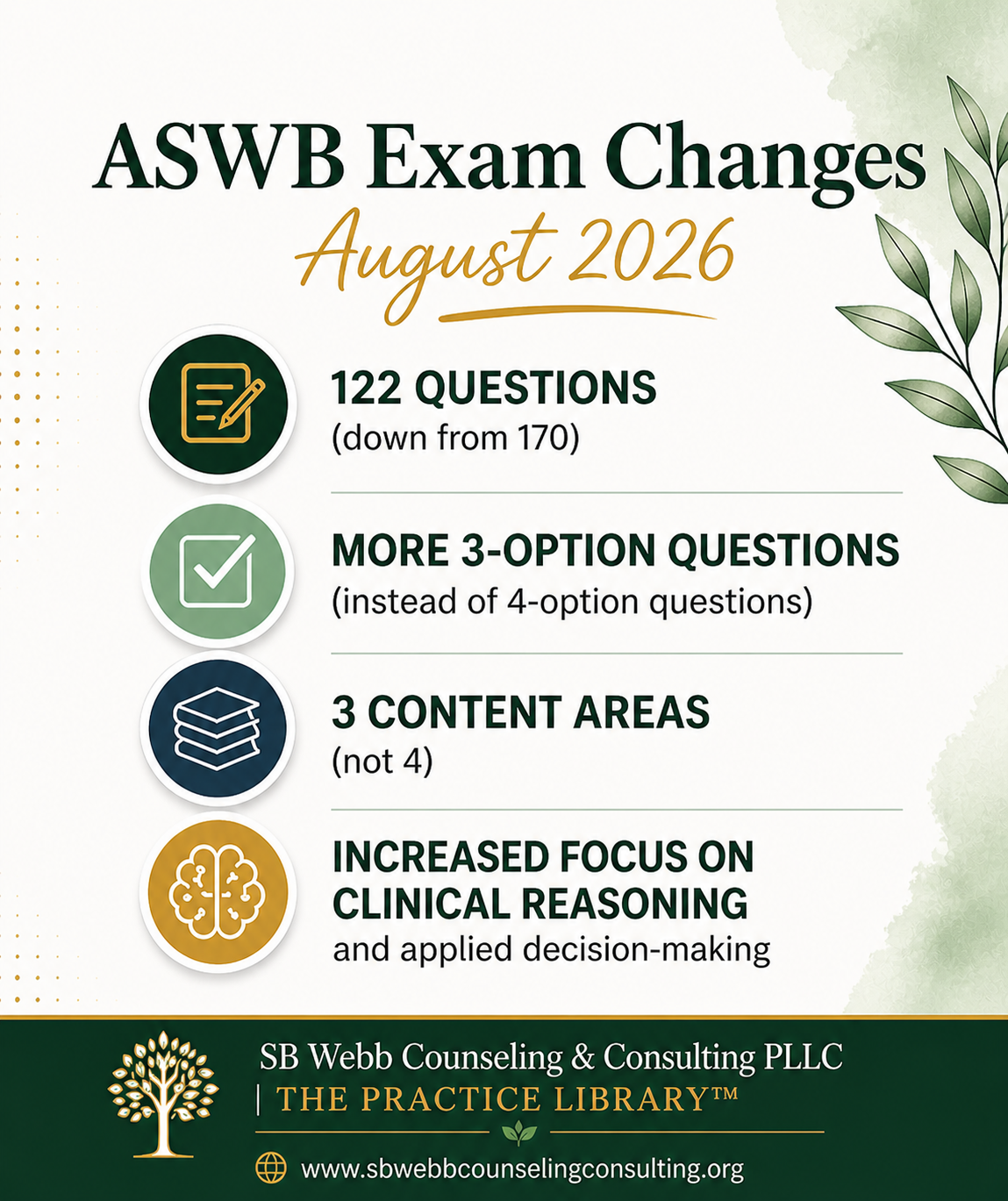
In August 2026, the ASWB licensure exams will change:
Fewer total questions
More questions with three answer options
A stronger emphasis on clinical reasoning and applied decision-making
At first glance, this may seem like a testing update.
But it reflects something much bigger:
A shift toward evaluating how clinicians think—not just what they know.
This shift becomes more tangible when we look at the structural changes to the exam:
“The social work licensing exams are designed to determine whether candidates have the knowledge, skills, and abilities required for competent practice.”
What We Know (and What We Don’t Yet Know)
The structural changes are clear. The exam will include fewer questions overall, with a reduction in unscored pilot items. The content will be reorganized into three domains, and there will be a greater emphasis on applied knowledge rather than recall.
What remains less clear is exactly how these changes will feel in practice. We do not yet have full visibility into the question style, level of nuance, or how preparation materials will evolve.
But we do know the direction:
This is an exam that is moving closer to real-world clinical thinking.
“ASWB has indicated that the updated exams emphasize the application of knowledge in practice rather than simple recall.”
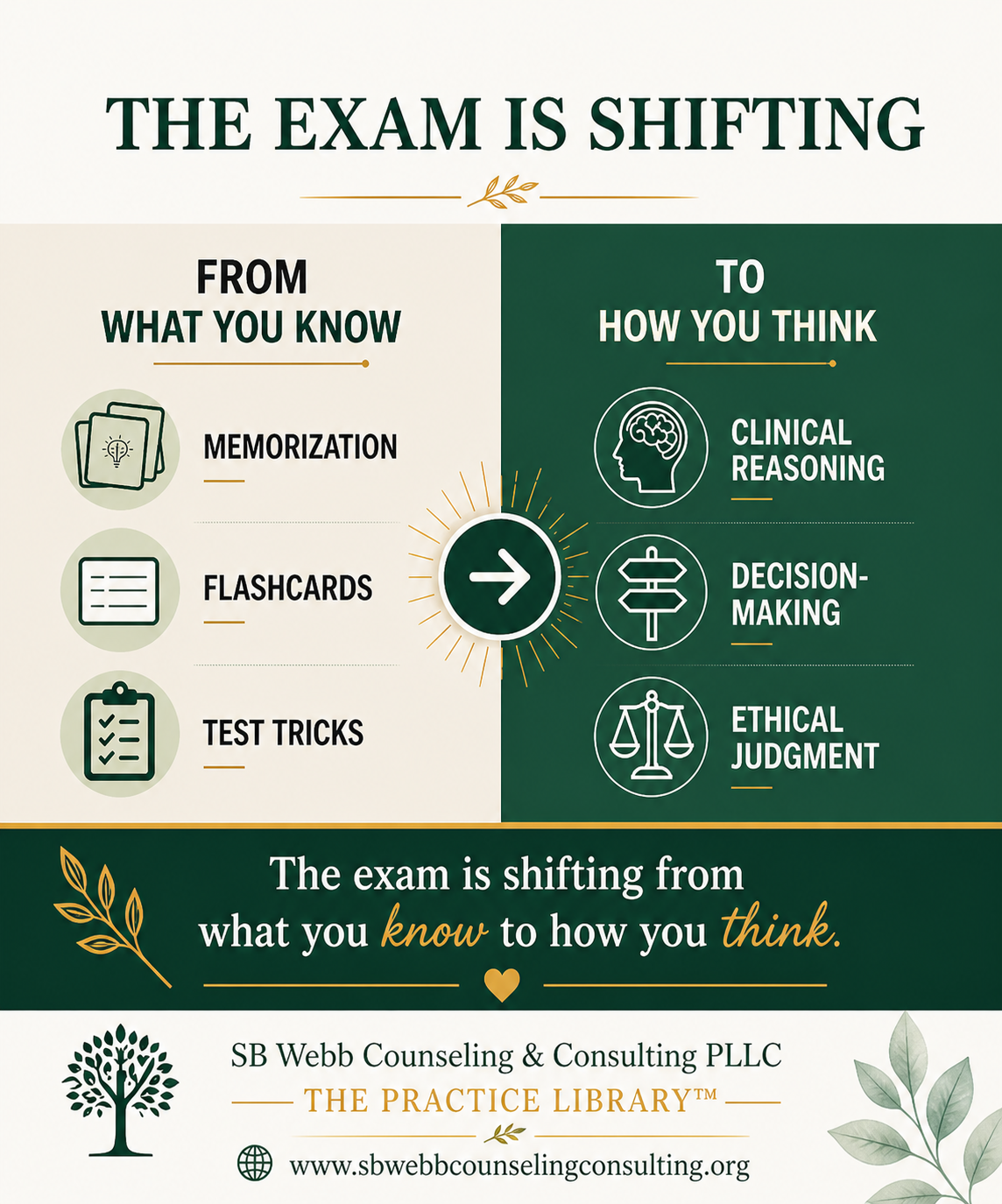
A Shift from Memorization to Clinical Judgment
For years, many clinicians have approached licensure exams with a focus on memorization—diagnostic criteria, terminology, and test-taking strategies designed to narrow down the “correct” answer.
This shift challenges that approach.
Clinical work rarely presents with four clearly defined options, two of which can be easily eliminated. Instead, it requires prioritization, ethical reasoning, and decision-making under uncertainty.
“The question isn’t just whether you know something—it’s whether you can use it.”
If the exam is evolving to reflect this reality, then preparation must evolve as well.
At its core, this change represents a fundamental shift:
Not just in how the exam is structured—but in how we define readiness for clinical practice.
Rethinking the Test Prep Industry
Over time, an entire industry and infrastructure has developed around test preparation—often reinforcing the belief that passing requires significant financial investment in courses, materials, and strategies.
For many, this creates an additional barrier in an already demanding process.
And while those resources can be helpful, they are not the only path to readiness.
In my own experience, what supported me most was far more accessible:
Listening to foundational content, such as the Social Work Podcast by Jonathan Singer, while driving in the field
Engaging in ongoing conversations with my supervisor about case presentations and clinical scenarios
Exploring how real-world situations connected to theory, ethics, and values
This process wasn’t about memorizing content—it was about developing a way of thinking. It was slower, more reflective—and ultimately more aligned with how clinical work actually happens.
This is where the shift becomes most clear:
If the exam is moving toward assessing clinical reasoning, this may create an opportunity to level the playing field. Preparation may become less about access to costly resources and more about the ability to reflect, apply knowledge, and engage in meaningful clinical dialogue.
What This Means for Students and Associates
For those currently preparing for licensure, this shift may feel both encouraging and uncertain.
On one hand, it suggests a move away from memorization-heavy strategies. On the other, it places greater emphasis on clinical judgment—something that develops over time.
This reinforces the importance of:
Actively engaging in supervision
Asking “why” behind clinical decisions
Practicing case-based reasoning, not just content review
Preparation is no longer just about studying—it’s about thinking.
What This Means for Supervisors
For supervisors, this change is especially important.
We are not just supporting clinicians in passing an exam—we are helping them develop the ability to make sound, ethical, and effective decisions in practice.
This means:
Creating space for discussion, not just direction
Exploring multiple possible responses to clinical scenarios
Helping supervisees understand why one approach may be more appropriate than another
It also highlights an ongoing need in our field: We need more approved supervisors.
This is not just a testing issue—it’s a supervision issue:
And it requires us, as a field, to take that responsibility seriously.
As the pathway to licensure continues to evolve, access to high-quality supervision becomes even more critical. Developing clinical reasoning cannot be outsourced—it is built through relationship, reflection, and guided experience.
“Developing clinical judgment cannot be outsourced—it is built through supervision, conversation, and experience.”
A Broader Conversation About Access
This shift also invites us to consider access more broadly.
Will these changes make the exam more reflective of real-world practice?
Will they reduce barriers—or introduce new ones in different ways?
“If preparation becomes more about thinking than spending, this shift could help level the playing field.”
And how do we ensure that clinicians from all backgrounds have the support they need to move through the licensure process?
These are questions worth continuing to ask.
Moving Forward
This is less about making the exam easier or harder—and more about aligning it with how clinicians actually think in practice.
“This shift isn’t about making the exam easier or harder—it’s about aligning it with how clinicians actually think in practice.”
As a field, this is an opportunity to reflect:
How are we preparing clinicians?
What are we prioritizing in supervision?
And how do we support not just passing an exam—but becoming a competent, confident practitioner?
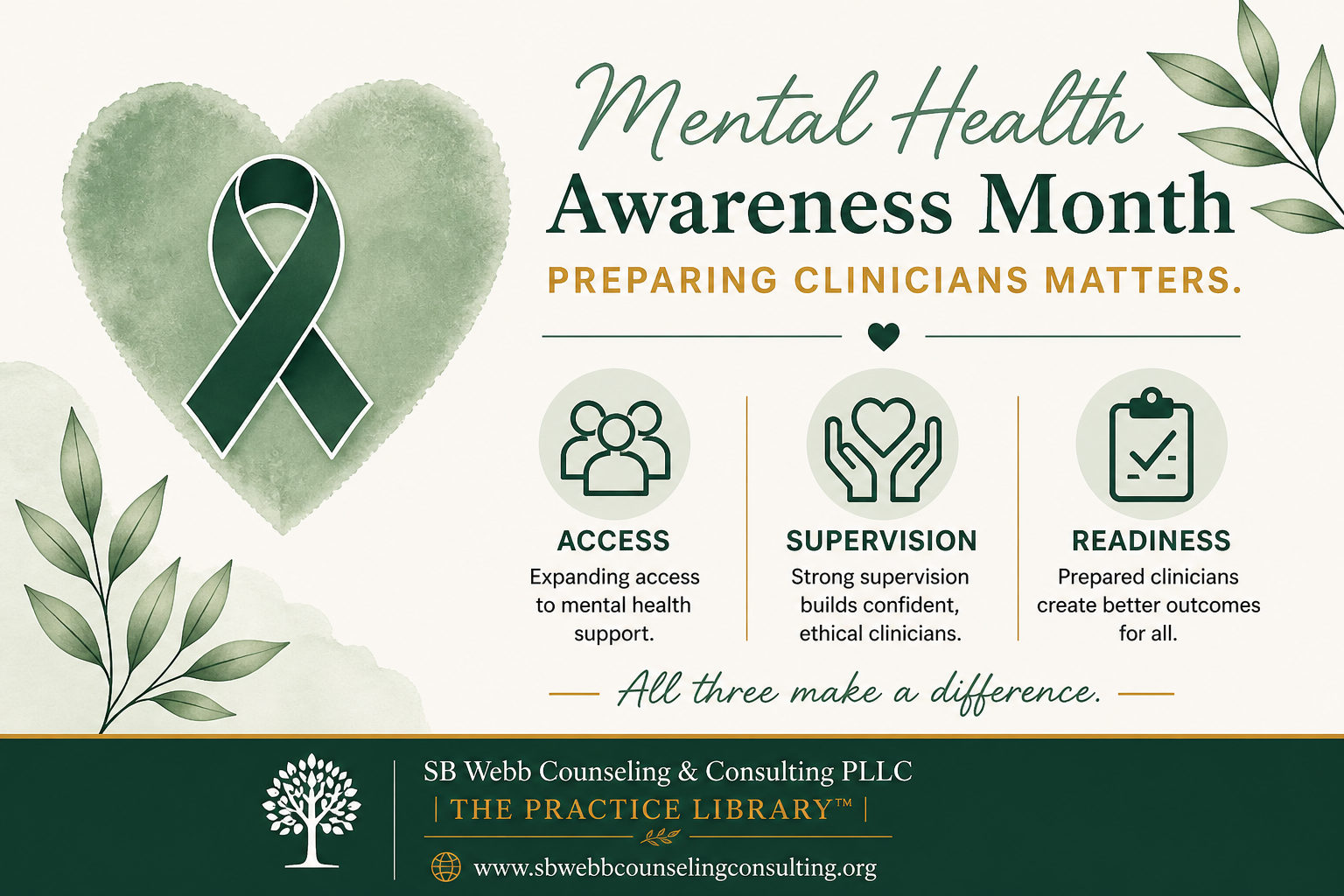
This conversation connects to a broader responsibility within our field:
Because how we prepare—and support—clinicians doesn’t just impact exam outcomes.
It shapes the quality of care our communities receive.
References
Association of Social Work Boards. (2024–2026). Upcoming changes to the social work licensing exams.
https://www.aswb.org/upcoming-changes-to-the-social-work-licensing-exams/
Association of Social Work Boards. (n.d.). Examination program overview.
https://www.aswb.org/exam/
Singer, J. B. (Host). (n.d.). The Social Work Podcast.
https://socialworkpodcast.blogspot.com/
National Association of Social Workers. (2021). Code of ethics of the National Association of Social Workers.
https://www.socialworkers.org/About/Ethics/Code-of-Ethics/Code-of-Ethics-English
SB Webb Counseling & Consulting PLLC | The Practice Library™
Clinical supervision and consultation with integrity, structure, and relational mentorship.
sbwebbcounselingconsulting.org
If you’re seeking clinical supervision or consultation grounded in clinical thinking, structured reflection, and systems-informed practice, you can learn more below—and explore how this work develops over time.
Stay Connected
I share articles, clinical reflections, and supervision resources through The Practice Library™