

What Happens After the Interview: Onboarding, Culture, and the Systems That Shape Clinical Practice
SB Webb Counseling & Consulting PLLC | The Practice Library™
sbwebbcounselingconsulting.org
In behavioral health, we spend a significant amount of time thinking about hiring.
We refine interview questions.
We assess clinical fit.
We evaluate experience, training, and alignment with values.
But far less attention is given to what happens next.
And yet, what happens after the interview is where most of the long-term outcomes are actually determined.
“Onboarding is not where work begins—it’s where clinical practice is shaped”
This builds on what I explored in The First Five Years of Clinical Practice: Why Therapists Burn Out Early—where early career burnout is not a failure of resilience, but a reflection of how clinicians are developed and supported within systems.
Because onboarding is not just about getting someone started—it is where clinicians learn:
How to practice
How to ask for help
How to think within a system
Whether it is safe to not know
And that shapes everything that follows.
Onboarding Is Not One Thing
In many settings, onboarding is treated as a brief administrative phase—something to complete before productivity begins.
In reality, onboarding is layered and multidimensional:
Pre-Onboarding
The period between offer acceptance and day one—where expectations, communication, and psychological entry into the role begin.HR Onboarding
Policies, compliance, and required documentation.Technical / EHR Onboarding
Learning systems, documentation platforms, and workflows.Structural Onboarding
Understanding how the organization actually functions—roles, decision-making, and communication pathways.Clinical Onboarding
Documentation standards, risk assessment expectations, case conceptualization, and what “good care” looks like in this setting. This includes not only how to complete documentation, but how to use documentation as a reflection of clinical thinking—something explored further in The Clinical Intake: Where Diagnosis, Treatment, and Modality Begin and Documentation Is Clinical Thinking Made Visible.Relational Integration
Meeting the people you will work with—supervisors, prescribers, care coordinators, and team members.
This last piece is often overlooked—and it is one of the most important.
Relational Integration and the Cost of Not Knowing Each Other
I need to tell you all something here:
“When clinicians don’t know each other, they don’t consult each other.”
They hesitate to ask questions.
They feel unsure about when or how to staff a case.
They begin to internalize uncertainty as inadequacy rather than a normal part of clinical work.
Over time, this creates silos. This reflects a broader pattern in clinician development—one that extends beyond supervision alone, as explored in The Supervision Ecosystem: Why Therapists Develop Through Community, Not Supervision Alone.
And those silos don’t just affect workflow—they affect clinical decision-making, confidence, and ultimately client care.
Emile Durkheim’s work on the division of labor highlights that when roles within a system are not clearly defined or integrated, fragmentation occurs.
Without intentional integration, professionals begin to operate in parallel rather than in coordination
In clinical settings, this fragmentation shows up as siloed practice, limited consultation, and reduced cohesion across care teams.
Patrick Lencioni’s work on team functioning emphasizes that trust—particularly vulnerability-based trust—is foundational to effective teams. In clinical settings, this shows up in a very real way:
Do clinicians feel safe saying, “I’m not sure what to do here”?
If the answer is no, consultation decreases, isolation increases, and risk quietly rises.
Psychological Safety Is Clinical Infrastructure
Good onboarding creates space for:
Questions
Uncertainty
Collaboration
Real-time learning
Poor onboarding creates:
Silent struggle
Avoidance of consultation
Fear of being perceived as incompetent
Over-reliance on individual decision-making
Sociologist Erving Goffman described how individuals manage the “presentation of self” in social environments.
In clinical settings without psychological safety, clinicians may feel pressure to present as confident and competent—even when uncertainty is present—limiting opportunities for consultation and growth.
In a field defined by complexity, psychological safety is not a “nice to have.” This dynamic is often mislabeled as individual insecurity, when it is more accurately a function of system design, as explored in Beyond Imposter Syndrome.
It is part of the infrastructure of safe, effective care.
“Psychological safety is clinical infrastructure.”
The Tension: Productivity vs. Preparation
One of the most common barriers to thoughtful onboarding is time—specifically, non-billable time.
Behavioral health operates within broader economic structures that prioritize productivity, revenue, and measurable outputs. Within this model, onboarding is often compressed because it does not immediately generate income.
This creates a fundamental tension:
Are we optimizing for short-term productivity, or long-term sustainability?
In many settings, the answer is clear—even if it is not explicitly stated
Sociologist C. Wright Mills described the sociological imagination as the ability to understand how individual experiences are shaped by larger social structures. This tension is not new—it reflects broader challenges in how we structure and sustain the behavioral health workforce, as discussed in Uplift the Workforce.
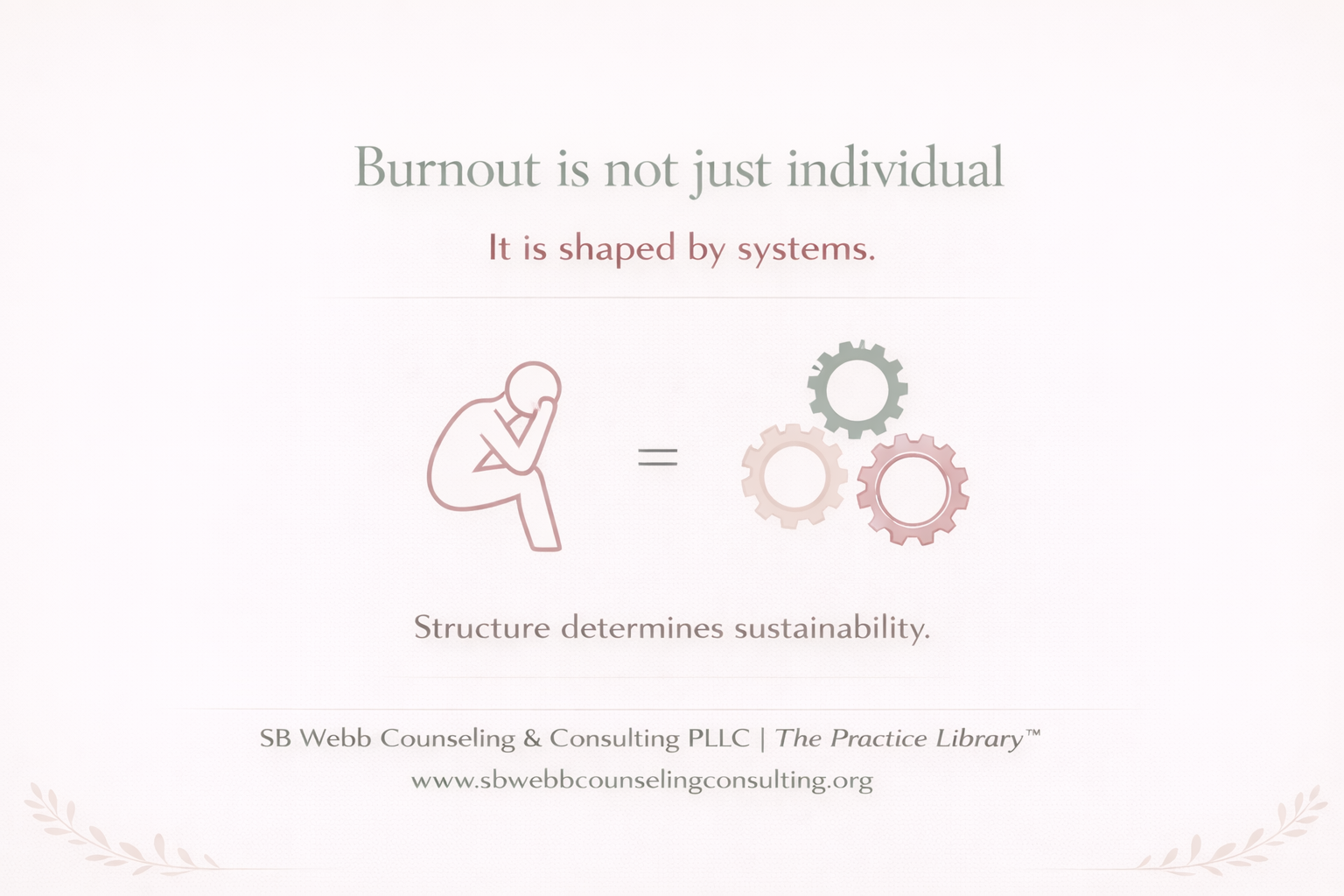
In behavioral health, burnout, turnover, and onboarding gaps are often framed as individual problems.
But more often than not, they are structural.
They reflect:
what systems prioritize
how quickly clinicians are expected to produce
and how much time is allocated for learning
What Are We Actually Asking of Clinicians?
When onboarding is limited, expectations are not.
Clinicians are often expected to:
Carry full caseloads quickly
Navigate complex systems
Make high-stakes clinical decisions
Maintain documentation and compliance standards
All while still learning how the organization functions.
And when challenges emerge, performance conversations often focus on productivity.
Which raises a necessary question:
“What are we actually measuring—and what are we assuming was taught?”
These gaps often become most visible in documentation and audit contexts, where expectations are clear—but training is not always aligned with what is expected in practice, as explored in What Auditors Actually Look For.
Onboarding Is a Retention Strategy
Thoughtful onboarding takes time. It often includes non-billable hours. And it can feel, at first glance, like a cost.
But the alternative is far more expensive.
Organizations invest significantly in:
Recruitment
Interviewing
Hiring processes
Credentialing
Initial training
When clinicians leave early, that investment is lost—and the cycle begins again.
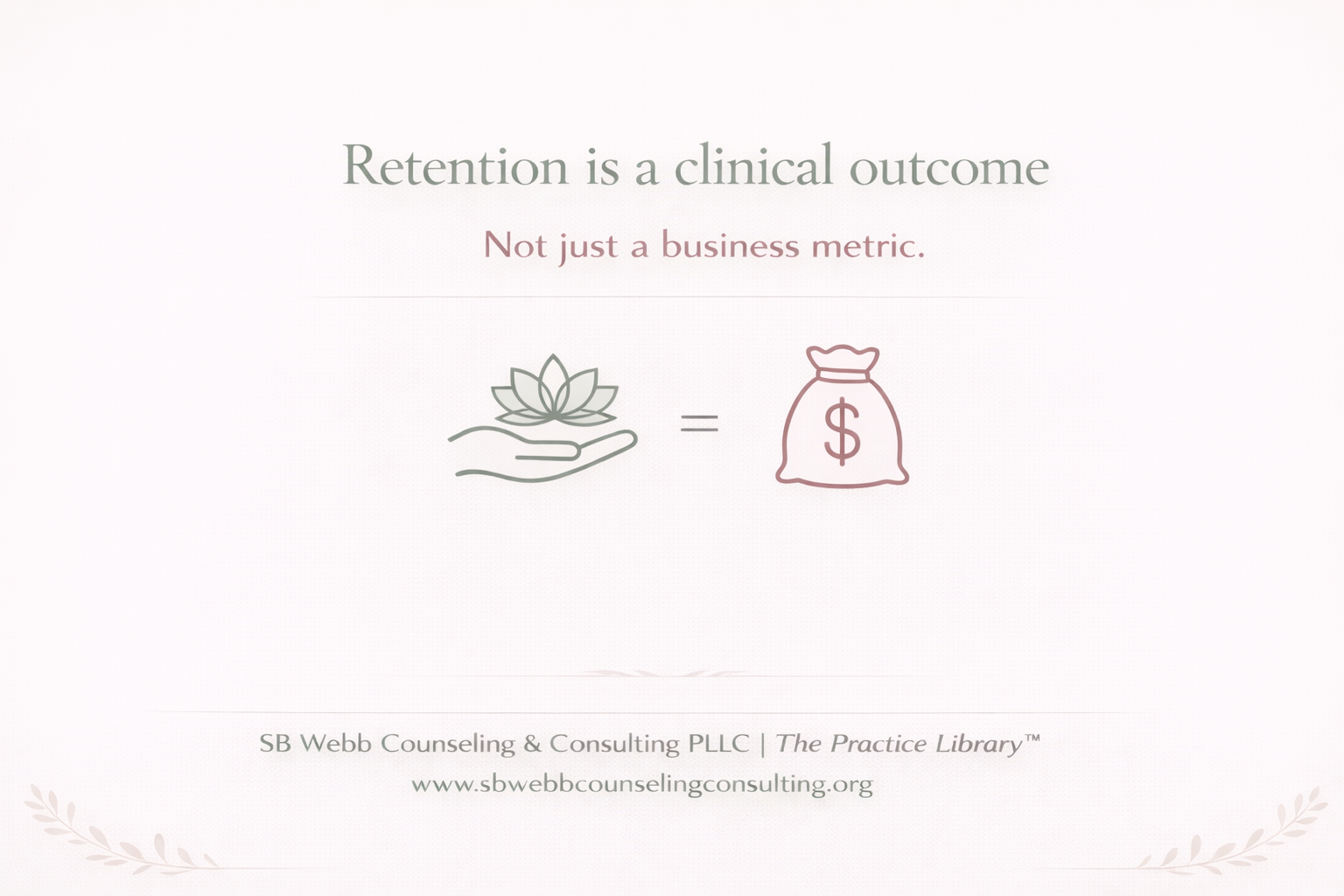
Retention is not just a financial metric.
It is a cultural and clinical one.
Turnover, Continuity, and Client Care
Continuity of care is widely understood to be a critical factor in mental health outcomes.
“Consistency in providers supports stability in outcomes.”
When clinicians leave:
Therapeutic relationships are disrupted
Trust must be rebuilt
Progress may stall or regress
These impacts are not evenly distributed.
Clients from marginalized communities—who may already face barriers to accessing care—are disproportionately affected by instability in provider relationships.
Equity, Belonging, and the Onboarding Experience
Onboarding does not affect all clinicians in the same way.
For providers from marginalized backgrounds, unclear expectations, lack of relational integration, and limited psychological safety can compound existing challenges related to belonging, representation, and systemic bias.
Neil Smelser’s theory of collective behavior suggests that group norms and practices can emerge and spread—even without formal structure or validation, even when they are not formally structured or evidence-based.
In onboarding, this can mean that informal practices—accurate or not—become embedded as “how things are done.”
Without intentional onboarding, organizations may unintentionally reinforce environments where some clinicians feel:
Less supported
Less connected
Less able to ask for help
This is not just a culture issue.
It is a retention issue.
The Workforce Reality
The behavioral health field is already navigating a workforce shortage, with ongoing concerns related to burnout and turnover.
Within this context, onboarding is not just an administrative phase.
It is:
a workforce strategy
a retention strategy
and a client care strategy
The long-term sustainability of this workforce depends on how well clinicians are supported—not just at crisis points, but from the beginning, as reflected in Who Helps the Helpers?.
Onboarding as a Trauma-Informed Practice
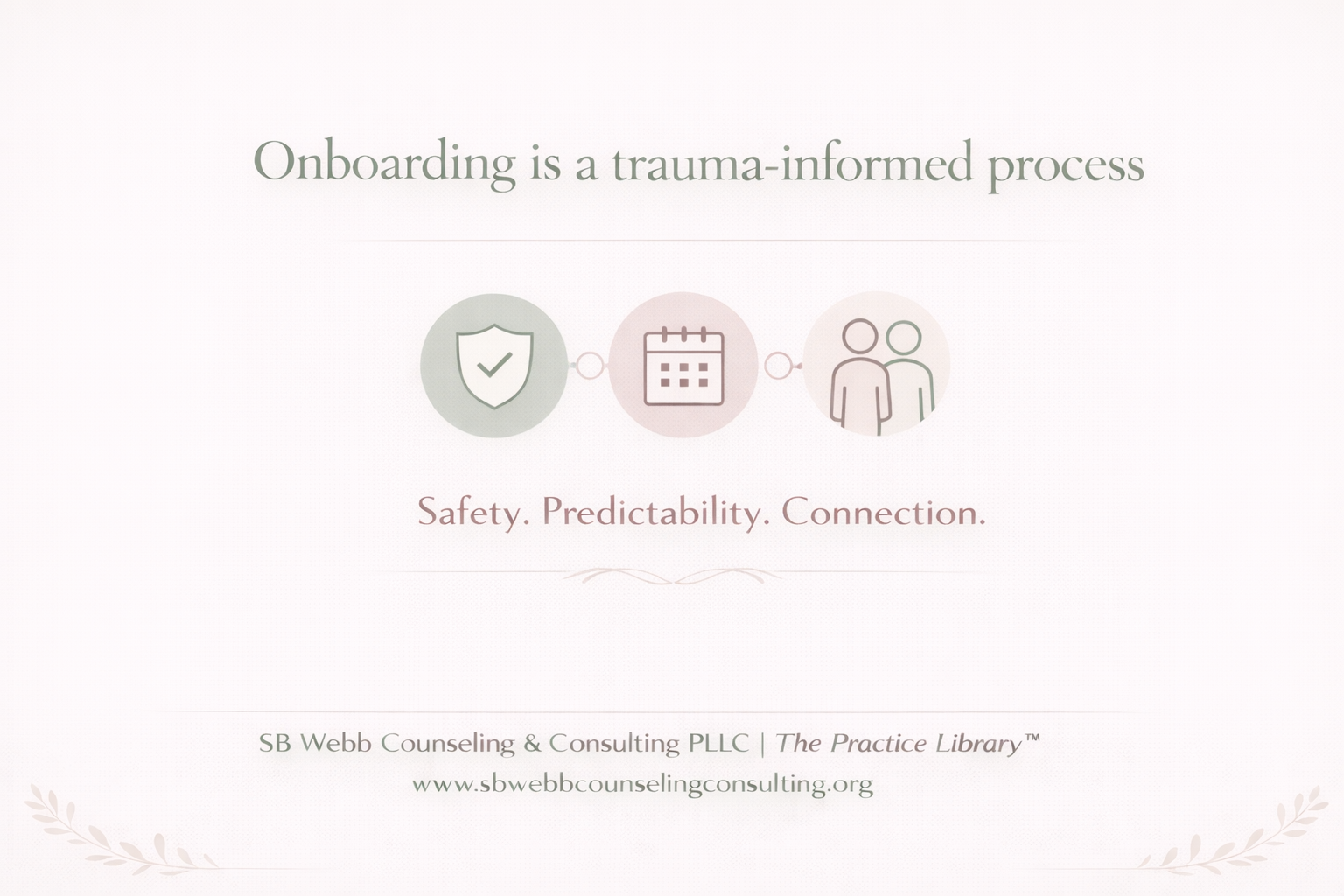
For clinicians entering new environments—particularly early career providers or those from marginalized backgrounds—onboarding is not just logistical. It is relational and psychological.
Trauma-informed frameworks emphasize:
safety
predictability
transparency
connection
These same principles apply to how clinicians are brought into organizations.
Without them, onboarding can replicate the very conditions we aim to mitigate in client care:
uncertainty
lack of control
fear of getting it wrong
Thoughtful onboarding, in this sense, is not just organizational best practice—it is trauma-informed practice applied to the workforce.
A Systems Perspective
Across sociological theory, a consistent theme emerges: individuals do not operate in isolation—behavior, performance, and outcomes are shaped by the structures, relationships, and expectations within which people work.
“Clinicians don’t struggle in isolation—systems shape outcomes”
How onboarding is structured
How expectations are communicated
Whether consultation is normalized
Whether learning is resourced
These are not individual variables—they are structural ones.
And they shape outcomes.
What Happens After the Interview Matters
Onboarding is not just about getting someone started.
It is the foundation of:
clinical quality
team culture
provider sustainability
and client outcomes
It is where clinicians learn whether they are part of a team—or expected to function alone.
It is where organizations demonstrate what they truly value—not in mission statements, but in practice.
Looking Ahead
As behavioral health continues to evolve—including the growing presence of technology and AI in care delivery—these questions become even more important.
Tools will change. Systems will adapt.
But the core of this work remains deeply human—rooted in relationship, trust, and clinical judgment developed over time.
If anything, this only strengthens the need to invest thoughtfully in clinicians from the very beginning—so they are not just prepared to function within systems, but to practice in ways that remain grounded, relational, and responsive to the people they serve.
Final Thought
If we want consistent, high-quality care for clients, we have to invest in the clinicians providing that care.
Not just in hiring them—but in how we bring them into the work.
“What happens after the interview doesn’t just shape the clinician—it shapes the system they practice within.”
Because what happens after the interview doesn’t just shape the clinician—it shapes the trajectory of their development, something we continue to see reflected across early career experiences, as explored in The First Five Years of Clinical Practice.
Selected References & Influences
Durkheim, E. (1893/1984). The division of labor in society (W. D. Halls, Trans.). Free Press.
Goffman, E. (1959). The presentation of self in everyday life. Anchor Books.
Lencioni, P. (2002). The five dysfunctions of a team: A leadership fable. Jossey-Bass.
Maslach, C., & Leiter, M. P. (2016). Burnout in the workplace: A review of the literature. Annual Review of Organizational Psychology and Organizational Behavior, 3, 397–422.
Mills, C. W. (1959). The sociological imagination. Oxford University Press.
Smelser, N. J. (1962). Theory of collective behavior. Free Press.
Substance Abuse and Mental Health Services Administration (SAMHSA). (2023). Behavioral health workforce report. U.S. Department of Health and Human Services.
Health Resources and Services Administration (HRSA). (2023). Behavioral health workforce projections. U.S. Department of Health and Human Services.
Carello, J., & Butler, L. D. (2015). Practicing what we teach: Trauma-informed educational practice. Journal of Teaching in Social Work, 35(3), 262–278.
SB Webb Counseling & Consulting PLLC | The Practice Library™
Clinical supervision and consultation with integrity, structure, and relational mentorship.
sbwebbcounselingconsulting.org
If you’re seeking clinical supervision or consultation grounded in structure, reflection, and systems-informed practice, you can learn more here.
Stay Connected
I share articles, clinical reflections, and supervision resources through The Practice Library™